AI agents can research, triage, coordinate, update systems, and complete multi-step tasks across approved tools. Good examples include lead qualification, support investigation, document exceptions, vendor review, reporting, scheduling, and internal service desks.
10 useful business agent examples
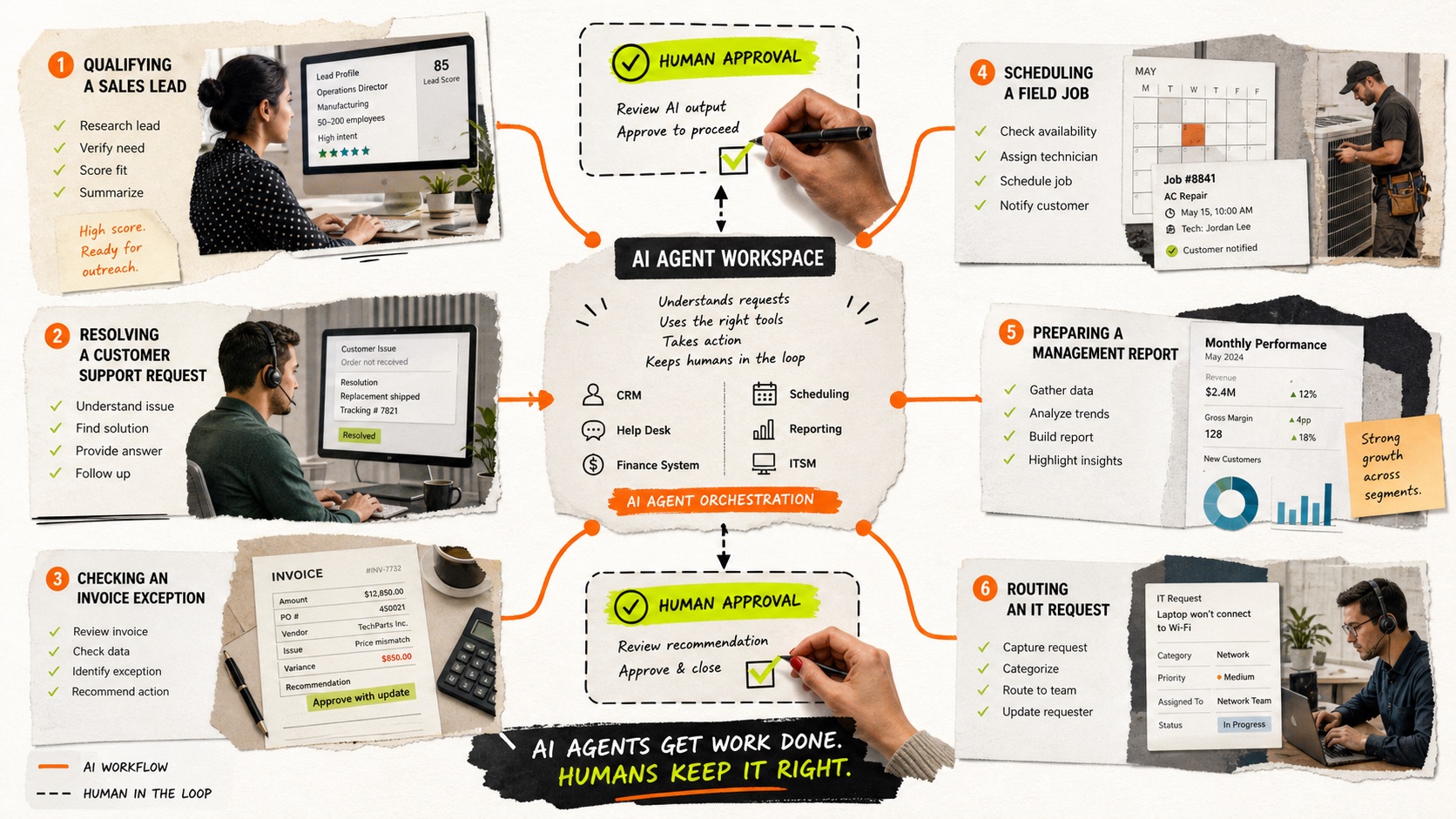
- Lead qualification agent: researches an inbound company, checks fit, drafts outreach, and updates the CRM for approval.
- Customer support agent: verifies context, searches approved knowledge, takes permitted account actions, and escalates exceptions.
- Sales follow-up agent: reviews meetings and deal history, proposes next steps, creates tasks, and prepares messages.
- Document exception agent: investigates missing or conflicting fields across an invoice, purchase order, and supplier record.
- Vendor review agent: gathers approved evidence, compares it with a checklist, and produces a cited report for a decision-maker.
- Internal IT agent: classifies requests, checks policy, performs low-risk fixes, and routes restricted actions.
- Reporting agent: gathers data from permitted systems, checks anomalies, prepares commentary, and schedules review.
- Scheduling agent: balances availability, location, skills, travel, and priority before proposing assignments.
- Knowledge maintenance agent: identifies stale procedures, finds conflicting guidance, and asks owners for updates.
- Operations coordinator: monitors a queue, follows up missing inputs, updates status, and alerts people when service levels are at risk.
What makes these systems agents
An agent has an outcome, instructions, context, and a controlled set of tools. During a task it can decide which permitted action to take next, observe the result, and continue until the work is complete or should be handed back.
The tools create both capability and risk. Reading a knowledge base is different from editing a customer record. Drafting an email is different from sending it. A production design should grant the minimum access required and place approval gates before consequential actions.
Fixed automation remains the better choice when every step is known in advance. The agent earns its complexity only when variation in the path is a genuine part of the work.
Start with one agent and a narrow toolset
Multi-agent diagrams can look sophisticated while hiding unnecessary coordination. A single agent with clear instructions and three well-defined tools is easier to evaluate, observe, and secure.
Split the design only when separate roles have meaningfully different instructions, permissions, context, or evaluation criteria. For example, research and final approval may need independent responsibilities. Do not add agents simply to imitate an organisational chart.
Use deterministic code for calculations, identity checks, policy rules, and record validation. Let the model handle interpretation and path selection where flexibility is actually needed.
Controls an agent needs before production
- Least-privilege access to tools, systems, and records.
- Explicit instructions for stopping, escalating, and refusing.
- Approval before sending, deleting, paying, publishing, or changing sensitive records.
- Logs that show inputs, tool calls, outputs, errors, and human decisions.
- Evaluation against normal cases, edge cases, adversarial inputs, and tool failures.
- Rate, time, and spending limits to prevent uncontrolled loops.
- A named operational owner and a way to disable the system quickly.
How to measure whether an agent is useful
Completion rate alone can be misleading. Measure correct completion, human correction, escalation quality, time to outcome, cost per task, policy violations, customer impact, and failures by tool or step.
Review the traces behind the numbers. A system may complete a task while taking wasteful steps, using weak evidence, or creating cleanup work elsewhere. Production quality means the result and the path are acceptable.
An agent should have enough freedom to handle variation and enough constraint that the business can understand, test, and stop it.
Sources and further reading
Research checked 23 July 2026. External guidance can change; confirm current legal, privacy, security, and vendor requirements for your situation. Read our editorial policy.
- A practical guide to building agents — OpenAI
- Workspace agents for business — OpenAI
- Building effective agents — Anthropic
Want to apply this to your own business?
BrainSwerve maps the workflow, checks where AI is useful, and designs the controls before anything is built.