A chatbot mainly handles a conversation. An AI agent can decide what step comes next and use tools to complete work across other systems. Some chatbots contain agents, but many only answer questions. Businesses should use the least autonomous design that can reliably complete the job.
The core difference is action
A chatbot is an interface. It accepts a message and returns a response. It may search a knowledge base, collect details, or hand a conversation to a person. That can be extremely useful, but conversation alone does not make it an agent.
An agent is a system that works towards an outcome with some independence. It can decide which tool to use, gather more context, take several steps, check whether the task is complete, and stop or hand back control when needed.
OpenAI's practical agent guidance describes agents as systems that independently accomplish tasks on a user's behalf, using a model to manage workflow execution and tools to gather information or take action. That is a much higher bar than adding a chat window to a website.
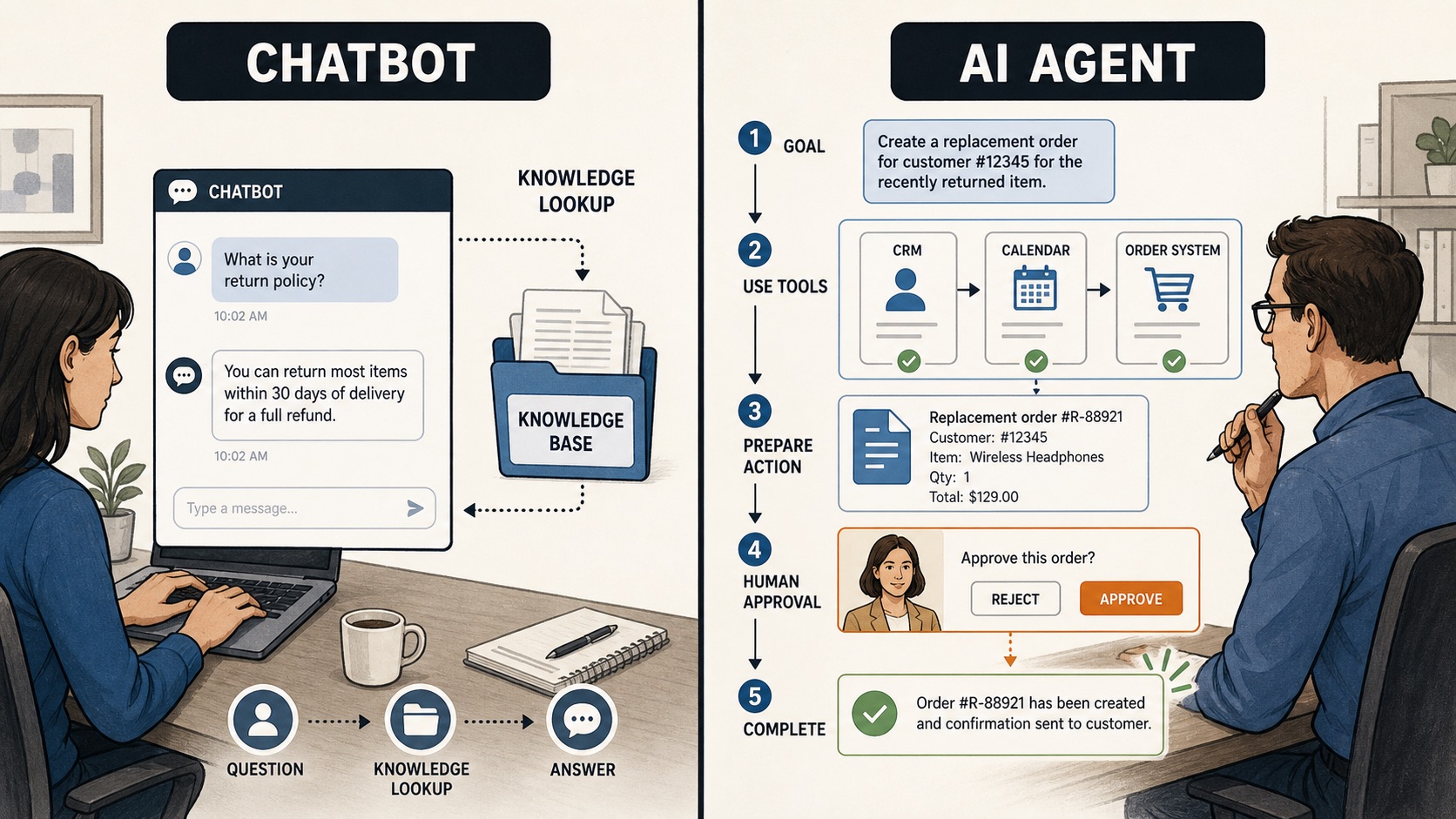
Chatbot, automation, or agent?
| Chatbot | Fixed automation | AI agent | |
|---|---|---|---|
| Main job | Hold a conversation. | Follow a known process. | Achieve an outcome. |
| Path | Usually guided by the user. | Defined in advance. | Chosen during the task. |
| Tools | Optional or limited. | Predefined integrations. | Selects from permitted tools. |
| Best for | FAQs, intake, search, support. | Repeatable data and workflow steps. | Ambiguous, multi-step work. |
| Risk | Incorrect information. | Bad rules or failed integration. | Incorrect decisions or actions. |
The same customer request, three ways
Imagine a customer asks, "Can I change the delivery address for my order?"
- A basic chatbot explains the policy and gives the customer a support link.
- A fixed automation updates the address if the order status and customer identity meet predefined rules.
- An agent verifies identity, checks the order and carrier status, decides whether the change is still possible, updates the right systems, and asks for human approval when the case falls outside policy.
The agent is more capable, but it also needs stronger identity checks, permissions, logging, testing, and escalation. If the fixed automation handles 95 percent of requests safely, adding autonomy may not be worth the extra complexity.
When each approach makes sense
Use a chatbot when
People need quick answers, guided intake, product discovery, internal knowledge search, or a better route to the right human. Make the system identify itself as AI and provide a clear escalation path.
Use a fixed automation when
The trigger, rules, and output are stable. Fixed workflows are usually easier to test, cheaper to operate, and more predictable. They should be the default for known processes.
Use an agent when
The work involves ambiguous language, several possible paths, unstructured documents, changing context, or tool selection that cannot be reduced to sensible rules. The value of that flexibility must justify the additional control work.
Controlled autonomy is the practical goal
A production agent should not have unlimited access. Give it only the tools and data required for the task. Separate read permissions from write permissions. Require approval for irreversible or high-impact actions. Log what it saw, decided, and changed.
Start with the agent making recommendations, then allow low-risk actions after its performance is measured. Keep high-risk actions behind a human checkpoint. This is slower than the most dramatic demo, but it is how a business earns trust in the system.
For many use cases, the best architecture is hybrid: fixed automation controls the workflow, a model handles one judgement-heavy step, and a person owns the exception queue.
Sources and further reading
Research checked 23 July 2026. External guidance can change; confirm current legal, privacy, security, and vendor requirements for your situation. Read our editorial policy.
- A practical guide to building AI agents — OpenAI
- Trustworthy agents in practice — Anthropic
- Guidance for AI adoption: foundations — National AI Centre
Want to apply this to your own business?
BrainSwerve maps the workflow, checks where AI is useful, and designs the controls before anything is built.