Do not enter personal, sensitive, confidential, or regulated information into a public AI tool unless your organisation has assessed and approved that exact use. Business-grade or custom AI can be used more safely, but only with suitable contracts, settings, access controls, data minimisation, testing, monitoring, and human accountability.
Classify the data before choosing the tool
"Company data" is too broad to support a useful decision. A public press release and a customer's medical history should not be treated the same way.
| Data class | Examples | Practical starting position |
|---|---|---|
| Public | Published website copy, public reports, approved product information. | Usually low risk, subject to accuracy and copyright checks. |
| Internal | General procedures, meeting notes, internal plans. | Use only in an organisation-approved product and workspace. |
| Confidential | Contracts, source code, pricing, financials, strategy. | Require vendor due diligence, strict access, retention controls, and approved use cases. |
| Personal or sensitive | Customer records, employee data, health, identity, financial or legal information. | Get privacy and security review before use; avoid public tools. |
Use the smallest amount of data needed for the task. Remove names and identifiers where possible. A model often needs the structure and context of a case, not every piece of information the business holds.
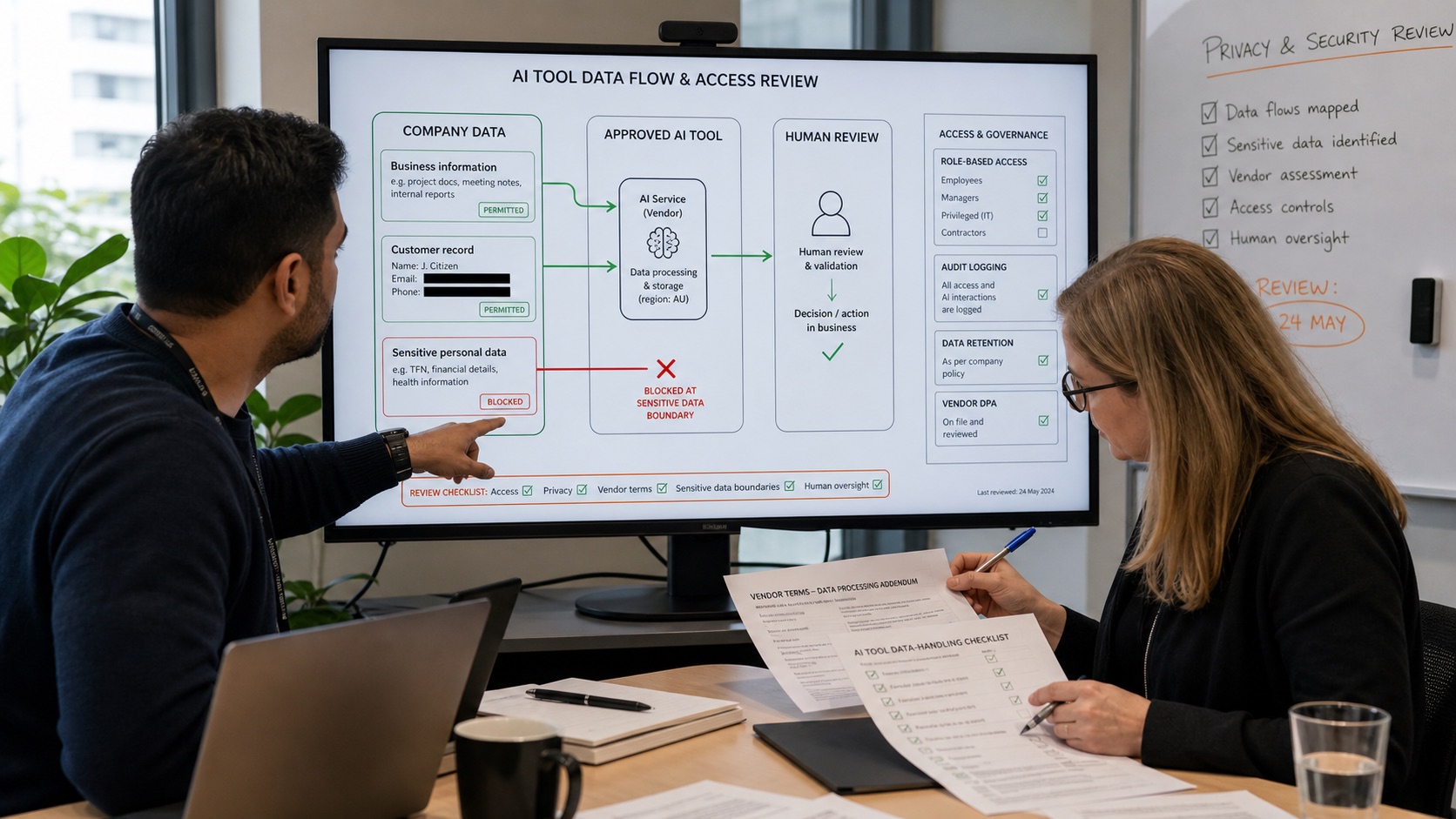
Public tools and managed business systems are not the same
A free public chatbot, a paid business workspace, an API integration, and a model running in a controlled cloud or on-premises environment can have very different terms and data flows. The product name alone does not answer the safety question.
Check the exact plan, account type, settings, region, and contract. Confirm whether inputs or outputs are used for model training, how long data is retained, who can access it, how deletion works, where it is processed, and whether the provider supports the controls your organisation needs.
The OAIC recommends that organisations do not enter personal information, particularly sensitive information, into publicly available generative AI tools because of the privacy risks. It also expects due diligence, human oversight, transparency, and privacy governance when commercial AI products handle personal information.
Questions to ask an AI vendor
- Is our data used to train or improve any model, and can that be disabled contractually?
- What is retained, for how long, and how can it be deleted?
- Where is data stored and processed, including backups and subprocessors?
- How are users authenticated and what role-based permissions are available?
- Can we log prompts, outputs, tool calls, and administrative changes?
- Which security certifications, testing practices, and incident processes apply?
- Can the system restrict access to approved data sources and approved actions?
- What happens to our data and configuration if we leave the service?
Answers should be recorded, not assumed from a marketing page. The required depth should match the consequences of the use case.
A sensible control baseline
- Accountability: name a senior owner for AI use and a responsible owner for each system.
- Approved tools: tell staff which products and account types are permitted.
- Data rules: define what may never be entered and what requires approval.
- Least privilege: give AI systems only the data and actions required for the use case.
- Human oversight: require review where errors could materially affect people, money, legal rights, or reputation.
- Testing: evaluate normal cases, edge cases, prompt injection, inaccurate outputs, and failure behaviour.
- Monitoring: retain appropriate logs, watch for drift, and provide a clear incident path.
- Transparency: tell customers when they are interacting with AI where that context matters.
The Australian Government's Guidance for AI Adoption sets out six essential governance practices and recommends that governance grow with the organisation's use of AI. A small business may begin with a short approved-tools policy and one accountable owner. A large organisation will need formal review, documentation, and control processes.
A one-page policy is better than silence
Staff are likely to use AI whether the organisation has a policy or not. A short, practical policy can reduce shadow use immediately. It should name approved tools, prohibited data, acceptable tasks, required review, record-keeping expectations, and who to ask when the situation is unclear.
Training should include examples from the actual workplace. "Do not share confidential data" is vague. "Do not paste client contracts, customer records, credentials, or unpublished financials into a public chatbot" is usable.
This article is general information, not legal or cybersecurity advice. Businesses handling sensitive or regulated data should obtain advice for their obligations and architecture.
Sources and further reading
Research checked 23 July 2026. External guidance can change; confirm current legal, privacy, security, and vendor requirements for your situation. Read our editorial policy.
- Privacy and commercially available AI products — OAIC
- Guidance for AI adoption: foundations — National AI Centre
- Generative AI Profile for the AI Risk Management Framework — NIST
Want to apply this to your own business?
BrainSwerve maps the workflow, checks where AI is useful, and designs the controls before anything is built.