A narrow AI pilot may take two to six weeks. A focused production workflow often takes six to sixteen weeks, while multi-system or enterprise deployment can take several months. Process clarity, integrations, data, risk, testing, and approvals affect the timeline more than model setup alone.
Typical implementation timelines
| Scope | Typical planning range | What is included |
|---|---|---|
| Existing-tool experiment | Several days to 2 weeks | Configuration, sample testing, limited users, no critical integration. |
| Narrow pilot | 2-6 weeks | Defined workflow, representative data, human review, baseline measurement. |
| Focused production workflow | 6-16 weeks | Integrations, permissions, evaluation, monitoring, training, support. |
| Multi-system agent or department rollout | 3-9 months | Complex access, governance, change management, phased deployment. |
| Enterprise capability | 6-18 months and ongoing | Shared platform, standards, portfolio governance, adoption, continuous improvement. |
These are broad planning ranges, not delivery promises. A small but poorly understood workflow can take longer than a larger process with clean APIs, clear ownership, and good test data.
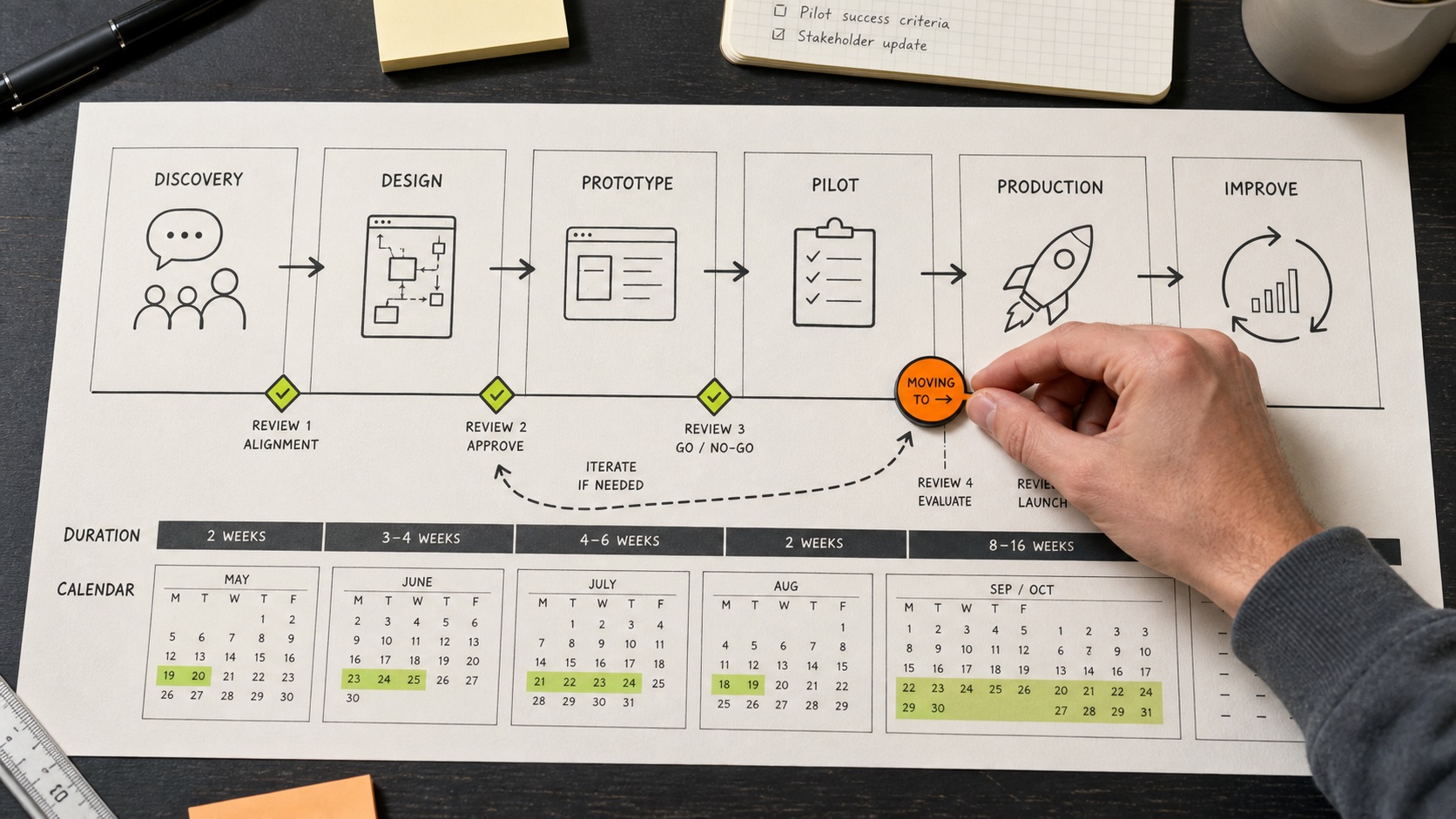
The six stages from idea to operation
- Discovery: define the problem, process, baseline, users, risks, and success measure.
- Design: choose the model, tools, integrations, data boundaries, approvals, and failure behaviour.
- Prototype: test the difficult AI step on representative examples.
- Pilot: run the complete workflow with limited users and human review.
- Production: add identity, permissions, monitoring, support, documentation, and change control.
- Operate and improve: review failures, data changes, model changes, cost, adoption, and business outcomes.
What usually slows implementation
- The process exists in people's heads rather than a shared procedure.
- Required data is scattered, inconsistent, inaccessible, or not permitted for the use.
- Legacy systems lack stable integration methods.
- No one owns acceptance criteria or exception decisions.
- The project begins with broad autonomy instead of a bounded workflow.
- Security, privacy, legal, and procurement review starts after the build.
- Testing uses neat examples and discovers real variation late.
- Training and revised operating procedures are treated as launch-day tasks.
How to move faster without skipping controls
Choose a workflow with a named owner, stable inputs, accessible data, and an existing review point. Collect real examples during discovery and include messy cases early.
Reuse approved infrastructure and integration patterns. Decide privacy, security, and procurement requirements before selecting the final tool. Keep the first release narrow enough that staff can understand and monitor it.
OpenAI's use-case guidance describes a staged process of defining, preparing data, building and testing, launching, then improving and scaling. Microsoft similarly emphasises that organisational, data, and business factors are part of the roadmap, not additions to the technology.
How to know the system is ready
Production readiness means the business has tested normal and abnormal cases, set acceptance thresholds, assigned owners, documented permitted use, trained users, enabled monitoring, defined support, and rehearsed disabling or reverting the workflow.
A pilot can tolerate manual observation. A production system needs a reliable queue for failures and a process for reviewing changes to models, prompts, data, and connected software.
The finish line is not the first correct output. It is a workflow the organisation can operate, explain, measure, and improve.
Sources and further reading
Research checked 23 July 2026. External guidance can change; confirm current legal, privacy, security, and vendor requirements for your situation. Read our editorial policy.
- Identifying and scaling AI use cases — OpenAI
- AI Strategy Roadmap — Microsoft
- Guidance for AI adoption: foundations — National AI Centre
Want to apply this to your own business?
BrainSwerve maps the workflow, checks where AI is useful, and designs the controls before anything is built.