Yes. Any business whose staff use AI should have a practical AI policy. A small organisation may need only a concise approved-tools and data-handling policy; larger or higher-risk organisations need formal roles, risk assessment, documentation, monitoring, and review.
Why a policy is needed before formal AI projects
Staff can already access public AI tools, browser features, meeting transcription, writing assistants, image generators, and AI features inside ordinary business software. Waiting for a major implementation leaves everyday use unmanaged.
A policy creates a shared baseline. It reduces accidental disclosure, inconsistent customer communication, unreviewed decisions, shadow tools, and confusion about who owns a problem.
Australian Government business guidance recommends processes and guidelines for responsible use, including approved purposes, accountability, risk management, personal data, customer transparency, and staff training.
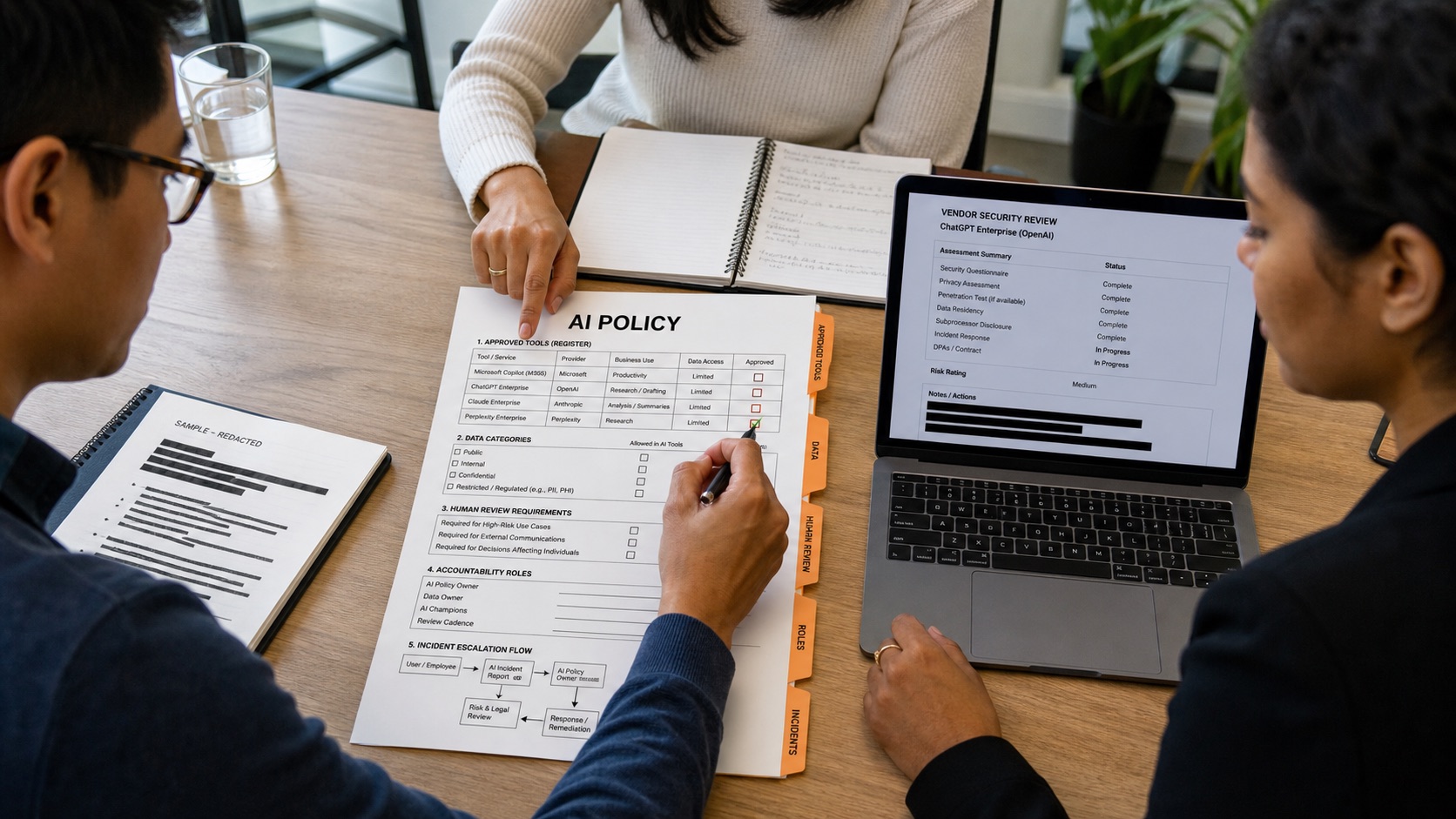
What a useful AI policy should cover
- Purpose and principles: why the organisation uses AI and the standards it will follow.
- Scope: staff, contractors, business units, tools, and use cases covered.
- Approved and prohibited uses: specific examples people can recognise.
- Data rules: what personal, confidential, regulated, or client information may be entered where.
- Human review: which outputs require checking and who may approve consequential actions.
- Transparency: when customers, staff, or partners should be told about AI use.
- Procurement and risk: how new tools and use cases are assessed.
- Records and monitoring: what must be logged, retained, tested, and reviewed.
- Incidents: how suspected disclosure, harmful output, or control failure is reported.
- Ownership: accountable executive, system owners, and policy review cycle.
Make the data rules concrete
Do not rely on a sentence such as "use AI responsibly". Name categories and examples: customer records, health information, credentials, contracts, employee matters, unpublished financials, source code, and client-confidential material.
The OAIC advises organisations to conduct due diligence on commercial AI products, embed human oversight, consider access to personal information, and avoid entering personal or sensitive information into publicly available generative AI tools as a matter of best practice.
Different tools may have different contractual and technical protections. Maintain an approved-tool register that records the owner, purpose, data class, access method, retention, and review date.
Scale the policy to the organisation
Small business
A two-page policy can name approved tools, prohibited data, allowed tasks, review requirements, and one accountable owner. Discuss it with staff and contractors rather than placing it unread in a folder.
Medium business
Add a use-case register, risk tiers, procurement questions, system owners, training, incident response, and periodic review.
Large or regulated organisation
Connect AI governance with privacy, security, legal, records, model risk, procurement, enterprise architecture, and assurance. High-impact systems need formal evaluation and ongoing monitoring.
Turn the policy into an operating process
- Use the Australian Government AI Policy Guide and Template as a baseline.
- Adapt it to actual tools, data, obligations, and language used by the organisation.
- Give staff short scenario-based training.
- Create a simple route for approving a new tool or use case.
- Review incidents, exceptions, and vendor changes.
- Update the policy on a scheduled cycle and when risk materially changes.
A policy becomes useful when a person can apply it to the document, customer request, or AI feature in front of them.
This article is general information and is not legal, privacy, or cybersecurity advice.
Sources and further reading
Research checked 23 July 2026. External guidance can change; confirm current legal, privacy, security, and vendor requirements for your situation. Read our editorial policy.
- Create an AI policy — National AI Centre
- Artificial intelligence for business — business.gov.au
- Privacy and commercially available AI products — OAIC
Want to apply this to your own business?
BrainSwerve maps the workflow, checks where AI is useful, and designs the controls before anything is built.